CALBLOCK-PV-025: VIS PSF Calibration (DEACTIVATED)
Observation configuration file
Not applicable (deactivated)
Scheduling
Once. The telescope must have been thermally stable for at least 5-7 days.
In case of failure, repeat at next possible opportunity, taking into account the thermal stabilization period.
Time-critical
No.
Objective
These calibrations are not simply trying to get high SNR observations of the PSF as it is in the Wide survey. Instead, we aim to measure and calibrate the models of the underlying contributing components that vary with spacecraft attitude. From the set of calibrated models we build a basis set that then can be applied to any subsequent observation at any attitude. This is a subtle but important difference.
The PSF is made up of many effects, broadly characterised into optical, detector and guiding error. Guiding error is time variable, but we should have good measurements of guiding error from the AOCS time series. The main unknown time-variable component is the telescope optical wavefront error. It is the aim of these PSF calibration observations to measure this component as free as possible from contamination by the other effects. CALBLOCK-PV-008: Phase Diversity Calibration observations allow extremely good separation of effects, which is why this is the primary calibration method. The subsequent measurements in-focus have much less good separation of optical and other effects, so these are not ideal but we believe we can use these to get the information we want.
So we do not want to reproduce wide survey conditions during the PSF calibration observations described here. We want to have the telescope in the most stable possible state - thermally stable at a particular spacecraft attitude and with minimum guiding error - so that we can best extract the wavefront error for this attitude from the data.
Thus the objective is to calibrate / validate the VIS PSF Model, using stars in the same magnitude range (17.5 < VIS < 21) as in the wide survey. The S/N must be 5x that of the wide survey.
Observations
The PSF field is observed 100 times. Ground-based SED information must be available for the sources in the field, the amount of which needs to be clarified (broad-band colors or actual SEDs).
It is important to know the SED of the stars observed. SEDs are available for brighter stars from Gaia, and therefore VIS could use shorter exposure times.
Fulfilling
Targets and pointing constraints
Pointing: A specific \({\rm AA}\) is required. AA must be kept stable during this block. Small changes within an individual exposure due to orbit progression are permissible. The pointings are launch-time dependent and will be provided by OU-SHE. There is no SAA constraint .
Suitable target fields have been selected near the ecliptic poles at a range of ecliptic longitudes to ensure year-round visibility.
Selection criteria for the target fields are as follows:
Absence of V<10 mag stars in the field of view
Absence of V<4 mag stars near the field of view (scattered light on the focal plane)
Absence of bright and extended sources (e.g., objects in the NGC- and IC catalogs)
Optical polarization \(\ll0.01\) and low galactic dust, as estimated from the Planck 353 GHz map
\(|{\rm ELAT}| \gtrsim 70^{\circ}\), to ensure constant visibility over consecutive weeks over the full SAA range
The GAIA stellar density at the Self-cal field is sufficient for the VIS PSF algorithm to run successfully. However, the Self-cal field can only be observed at a fixed SAA of 90 degrees and is therefore insufficient.
#ID |
R.A. |
Dec |
ELON |
ELAT |
GLON |
GLAT |
Comment |
VIS-PSF-1 |
292.48 |
53.53 |
321.00 |
73.00 |
85.33 |
16.16 |
|
VIS-PSF-2 |
285.03 |
49.83 |
302.00 |
71.60 |
79.93 |
19.07 |
|
VIS-PSF-3 |
275.78 |
47.80 |
282.00 |
71.00 |
75.93 |
24.30 |
|
VIS-PSF-4 |
265.72 |
48.09 |
261.00 |
71.40 |
74.83 |
30.97 |
|
VIS-PSF-5 |
254.20 |
49.37 |
237.00 |
71.00 |
75.94 |
38.61 |
|
VIS-PSF-6 |
247.27 |
52.69 |
220.00 |
72.20 |
80.91 |
42.58 |
|
VIS-PSF-7 |
239.80 |
56.89 |
200.00 |
73.00 |
88.18 |
45.55 |
|
VIS-PSF-8 |
235.16 |
60.85 |
184.00 |
73.80 |
94.79 |
45.96 |
|
VIS-PSF-9 |
225.35 |
61.91 |
172.50 |
70.50 |
100.21 |
49.09 |
|
VIS-PSF-10 |
221.47 |
67.43 |
155.00 |
71.50 |
107.55 |
46.13 |
|
VIS-PSF-11 |
215.61 |
73.55 |
135.00 |
71.00 |
114.45 |
42.05 |
|
VIS-PSF-12 |
– |
– |
– |
– |
– |
– |
Too far North for EXT |
VIS-PSF-13 |
43.34 |
-66.36 |
339.00 |
-71.80 |
285.75 |
-46.49 |
|
VIS-PSF-14 |
45.21 |
-61.46 |
353.50 |
-70.20 |
279.78 |
-49.44 |
|
VIS-PSF-15 |
54.60 |
-58.77 |
9.00 |
-72.30 |
272.38 |
-47.24 |
|
VIS-PSF-16 |
59.25 |
-55.16 |
23.00 |
-71.50 |
266.02 |
-46.46 |
|
VIS-PSF-17 |
65.30 |
-51.89 |
38.00 |
-70.90 |
260.15 |
-43.91 |
|
VIS-PSF-18 |
73.52 |
-49.10 |
56.00 |
-70.60 |
255.62 |
-39.06 |
|
VIS-PSF-19 |
81.34 |
-48.10 |
72.00 |
-71.00 |
254.49 |
-33.88 |
|
VIS-PSF-20 |
63.55 |
-49.19 |
39.00 |
-68.00 |
256.73 |
-45.53 |
|
VIS-PSF-21 |
185.90 |
78.10 |
119.02 |
64.98 |
124.77 |
38.93 |
|
VIS-PSF-22 |
150.00 |
78.50 |
109.74 |
59.25 |
132.49 |
35.23 |
|
VIS-PSF-23 |
87.60 |
-47.50 |
85.04 |
-70.90 |
254.36 |
-29.63 |
|
VIS-PSF-24 |
265.07 |
71.35 |
108.00 |
84.90 |
102.06 |
31.26 |
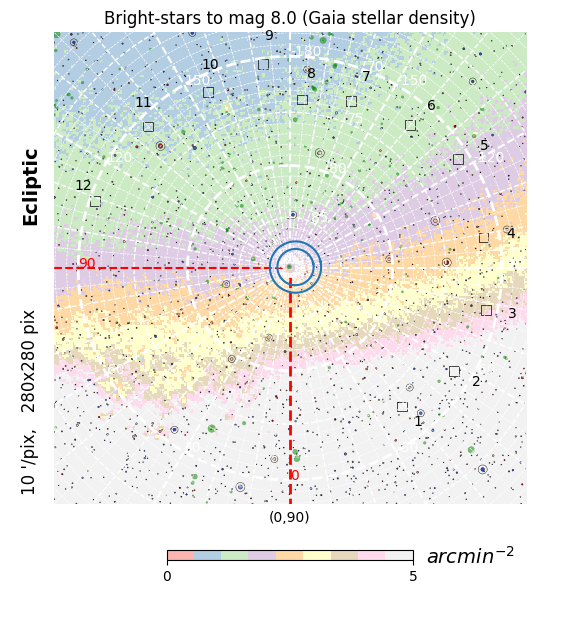
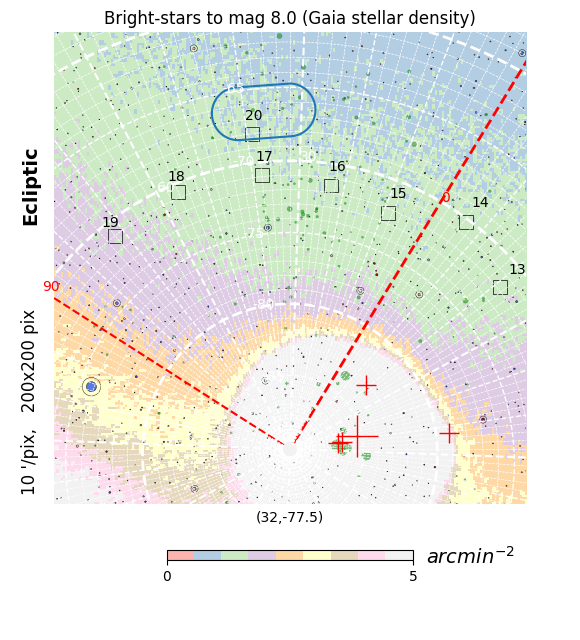
Figure: Northern ecliptic (left) and southern ecliptic (right) PSF fields.
Instrument configuration
Instrument: NI-CU off, VS-CU off
Methodology / Uplink procedure
Entity: VIS
Commanding Method:
Dither Sequence: Random offsets in a 3’ box
Inter-operability constraints
None
In-orbit duration
In-orbit Duration: 13 h (estimated from PDC atomic block)
Data volume
100*VS = 45200 MB
Processing input
Ground Processing Input Data: TBD
Data Description: 100 VIS science exposures
Processing output
TBD
Required accuracy, constraints
images successfully acquired
Processing tools
TBD
Quality control parameters
DataModel: https://gitlab.euclid-sgs.uk/
Contact person
VIS instrument scientist