CALBLOCK-F-008: VIS PSF Calibration and NISP photo nonlinearity
Observation configuration file
Scheduling
Must schedule the CALBLOCK-F-013: Phase Diversity PC-1ROS variant on the same target prior to beginning observations. This is needed to get the OU-PHZ data products for these fields.
The cadence of the PSF calibration fields is tied to the reference survey design (RSD), in particular the major thermal disturbances due to large slew angles or attitude changes. The PSF calibration fields will be taken with a contemporary survey patch, using similar spacecraft attitude angles. A PSF calibration field is observed about every 2 to 6 weeks. Not all survey patches or windows can be linked to a PSF calibration field due to field selection, and insufficient time for thermal stabilisation.
Due to the long replanning time and the involved thermal constraints, replanning would be a major effort. For the moment our strategy is therefore to simply skip the failed observation and wait for the next one. There is a risk that the PSF in the contemporary survey patch cannot be calibrated. Due to the long replanning time, that survey patch cannot be repeated immediately anyway and is therefore lost for immediate reobservation.
There are 12 different flavors due to NISP configurations. They must be cycled consecutively in the RSD, in this order of fluences: 8, 20, 80, 200, 450, 550, 12, 40, 150, 350, 750, 950 e-/s
The longer VIS component should be scheduled by EC-SURV.
Dependencies
F-012, F-015, and F-008 must be scheduled in this order as one set prior to the VIS PSF calibration (this CalBlock).
Objective
VIS: Calibrate / validate the VIS PSF Model, using stars in the same magnitude range (17.5 < VIS < 21) as in the wide survey. The S/N must be 5x that of the wide survey.
NISP: Take MACC(4,16,4) nonlinearity sequences in parallel. There are twelve different configurations, over which we cycle in a specific order (see Structure of the observation block.).
Observations
First, observe one CALBLOCK-F-013: Phase Diversity PC-ROS variant on the target.
The PSF fields must be observed 100 times with an exposure time of 289 seconds. Ground-based SED information must be available for the sources in the field, from ground-based observations for fainter stars, and from Gaia for brighter stars.
Dithering: At each dither point, one VIS Short Science (EXPTIME=289s) is executed. To avoid clustering of random dithers, we use points along a spiral. These produce a non-regular, yet fairly uniform distribution. In polar coordinates \((\rho, \theta)\), and for a total of \(n\) points, the position of point \(k\) is given by:
\((\rho, \theta) = (scale * \sqrt{k} / 60, k* GoldenAngle)\), with
\(scale = width / (2 \sqrt{n})\)
\(GoldenAngle = (3 - \sqrt{5}) * 180\;{\rm deg}\)
\(3' < width < 6'\) (chosen by EC-SURV according to their constraints)
NISP will take parallel ramps for CALPRODUCT-NI-011: NISP Nonlinearity Verification. These are off-sky. NISP has no pointing constraints. The number of ramps and subsequent darks depends on fluence. The number of darks taken must not change the overall execution time, that is all variants must have the same duration, driven by the parallel VIS observations. A ramp with higher fluence (950e-/s) than in PV is included to calibrate the highest end of the dynamic range.
Slew to VIS PSF field
NISP: Configure FWA = dark

VIS:
Repeat 100x:
   Take VIS science exposure with 289s duration
   Dither offset

------------
In parallel:

No NISP wheel movements permitted at any time.
Put NISP in "engineering RAW" mode
Turn on LED "C" with a selected fluence.
for detector in [1,...,16] (two at a time):
   if (fluence == 8 e-/s):   30 MACC(4,16,4) ramps
   if (fluence == 20 e-/s):  30 MACC(4,16,4) ramps
   if (fluence == 80 e-/s):  25 MACC(4,16,4) ramps
   if (fluence == 200 e-/s): 25 MACC(4,16,4) ramps
   if (fluence == 450 e-/s): 15 MACC(4,16,4) ramps
   if (fluence == 550 e-/s): 15 MACC(4,16,4) ramps
   if (fluence == 12 e-/s):  30 MACC(4,16,4) ramps
   if (fluence == 40 e-/s):  30 MACC(4,16,4) ramps
   if (fluence == 150 e-/s): 25 MACC(4,16,4) ramps
   if (fluence == 350 e-/s): 20 MACC(4,16,4) ramps
   if (fluence == 750 e-/s): 15 MACC(4,16,4) ramps
   if (fluence == 950 e-/s): 15 MACC(4,16,4) ramps

Turn off LED "C"
Put NISP in normal observation mode (no wheel movements)
Take MACC(15,16,11) darks until VIS is finished.
Fulfilling
Targets and pointing constraints
Pointing: Straylight suppression as per MOCDA-SYS-003. Specific SAA and AA are required. AA must be kept stable during the observation. Small changes within an individual exposure due to orbit progression are permissible. The angles must match the typical spacecraft attitudes achieved during the contemporary survey patch, and are thus provided by EC-SURV.
Suitable target fields have been selected near the ecliptic poles at a range of ecliptic longitudes to ensure year-round visibility.
Selection criteria for the target fields are as follows:
Absence of V<10 mag stars in the field of view
Absence of V<4 mag stars near the field of view (scattered light on the focal plane)
Absence of bright and extended sources (e.g., objects in the NGC- and IC catalogs)
Optical polarization \(\ll0.01\) and low galactic dust, as estimated from the Planck 353 GHz map
\(|{\rm ELAT}| \gtrsim 70^{\circ}\), to ensure constant visibility over consecutive weeks over the full SAA range
The GAIA stellar density at the Self-cal field is sufficient for the VIS PSF algorithm to run successfully. However, the Self-cal field can only be observed at a fixed SAA of 90 degrees and is therefore insufficient to calibrate the PSF of all survey patches.
#ID |
R.A. |
Dec |
ELON |
ELAT |
GLON |
GLAT |
Comment |
VIS-PSF-1 |
292.48 |
53.53 |
321.00 |
73.00 |
85.33 |
16.16 |
|
VIS-PSF-2 |
285.03 |
49.83 |
302.00 |
71.60 |
79.93 |
19.07 |
|
VIS-PSF-3 |
275.78 |
47.80 |
282.00 |
71.00 |
75.93 |
24.30 |
|
VIS-PSF-4 |
265.72 |
48.09 |
261.00 |
71.40 |
74.83 |
30.97 |
|
VIS-PSF-5 |
254.20 |
49.37 |
237.00 |
71.00 |
75.94 |
38.61 |
|
VIS-PSF-6 |
247.27 |
52.69 |
220.00 |
72.20 |
80.91 |
42.58 |
|
VIS-PSF-7 |
239.80 |
56.89 |
200.00 |
73.00 |
88.18 |
45.55 |
|
VIS-PSF-8 |
235.16 |
60.85 |
184.00 |
73.80 |
94.79 |
45.96 |
|
VIS-PSF-9 |
225.35 |
61.91 |
172.50 |
70.50 |
100.21 |
49.09 |
|
VIS-PSF-10 |
221.47 |
67.43 |
155.00 |
71.50 |
107.55 |
46.13 |
|
VIS-PSF-11 |
215.61 |
73.55 |
135.00 |
71.00 |
114.45 |
42.05 |
|
VIS-PSF-12 |
– |
– |
– |
– |
– |
– |
Too far North for EXT |
VIS-PSF-13 |
43.34 |
-66.36 |
339.00 |
-71.80 |
285.75 |
-46.49 |
|
VIS-PSF-14 |
45.21 |
-61.46 |
353.50 |
-70.20 |
279.78 |
-49.44 |
|
VIS-PSF-15 |
54.60 |
-58.77 |
9.00 |
-72.30 |
272.38 |
-47.24 |
|
VIS-PSF-16 |
59.25 |
-55.16 |
23.00 |
-71.50 |
266.02 |
-46.46 |
|
VIS-PSF-17 |
65.30 |
-51.89 |
38.00 |
-70.90 |
260.15 |
-43.91 |
|
VIS-PSF-18 |
73.52 |
-49.10 |
56.00 |
-70.60 |
255.62 |
-39.06 |
|
VIS-PSF-19 |
81.34 |
-48.10 |
72.00 |
-71.00 |
254.49 |
-33.88 |
|
VIS-PSF-20 |
63.55 |
-49.19 |
39.00 |
-68.00 |
256.73 |
-45.53 |
|
VIS-PSF-21 |
185.90 |
78.10 |
119.02 |
64.98 |
124.77 |
38.93 |
|
VIS-PSF-22 |
150.00 |
78.50 |
109.74 |
59.25 |
132.49 |
35.23 |
|
VIS-PSF-23 |
87.60 |
-47.50 |
85.04 |
-70.90 |
254.36 |
-29.63 |
|
VIS-PSF-24 |
265.07 |
71.35 |
108.00 |
84.90 |
102.06 |
31.26 |
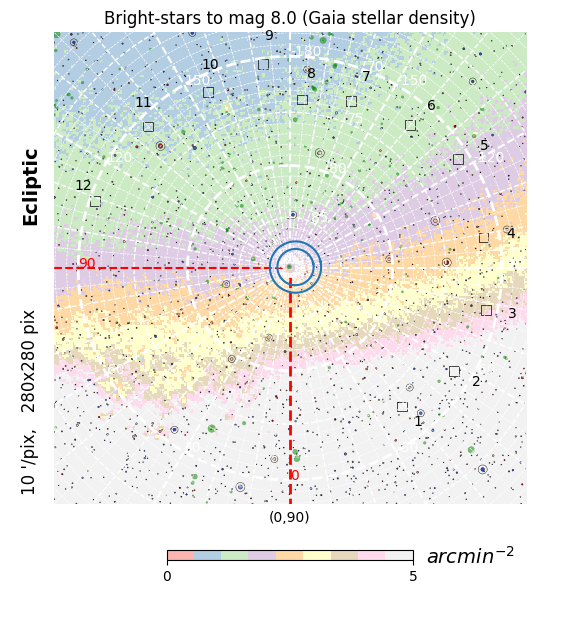
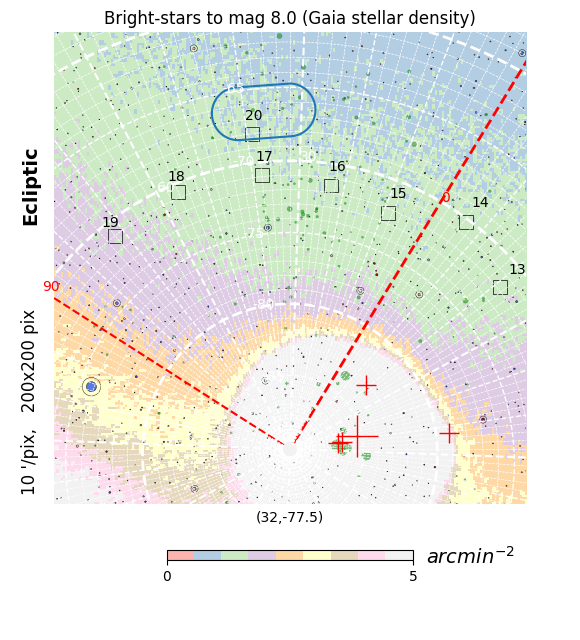
Figure: Northern ecliptic (left) and southern ecliptic (right) PSF fields.
Instrument configuration
Instrument: VIS: science.
NISP: Engineering Raw for the nonlinearity measurement. NI-CU on (see table below), NI-FWA closed, NI-GWA RSG000 for the nonlinearity measurement.
Uses non-standard photo-MACC(15,16,11) setting for the validation part.
# LED ‘C’ Flux [e-/s] |
I (mA) |
PWM [%] |
8 |
1.0 |
5.4 |
12 |
1.0 |
11.5 |
16 |
5.0 |
6.3 |
20 |
5.0 |
7.7 |
30 |
5.0 |
11.0 |
40 |
5.0 |
14.3 |
50 |
5.0 |
17.6 |
70 |
5.0 |
24.2 |
80 |
5.0 |
27.5 |
110 |
5.0 |
37.4 |
150 |
10.0 |
27.9 |
175 |
10.0 |
32.0 |
200 |
10.0 |
36.1 |
350 |
30.0 |
20.7 |
450 |
30.0 |
26.8 |
550 |
30.0 |
32.8 |
750 |
30.0 |
44.8 |
950 |
60.0 |
29.4 |
Methodology / Uplink procedure
Entity: VIS, NISP
Commanding Method: VIS: science. NISP: Observation / engineering RAW
Dither Sequence: Special. Computed dither pattern as defined in Observations.
Inter-operability constraints
NISP must not move any wheels during VIS operations. NISP must be configured before VIS starts taking data.
In-orbit duration
In-orbit Duration: 15 h
Data volume
One CALBLOCK-F-013: Phase Diversity PC-ROS variant
100*VS = 45200 MB
8000 to 16000 MB depending on the number of ramps per variant
Processing input
Ground Processing Input Data:
Data Description:
Recovery
Cannot be recovered. Continue with the survey plan.
Quality control parameters
DataModel: https://gitlab.euclid-sgs.uk/