CALBLOCK-F-013: Phase Diversity
Observation configuration file
Nominal F-013 OCFs still missing.
Scheduling
Once, ideally immediately after PV phase; optionally during a time of later unallocated survey time. Scheduled by EC-SURV.
In case of failure, repeat as soon as possible without change of the telescope’s thermal equilibrium. Otherwise, we need another thermal stabilization phase.
Time-critical
Yes. Must be executed ideally in one block to guarantee similar (and low) molecular contamination levels. Should be executed before the start of the routine survey observations.
The PC-1ROS variant must be scheduled immediately prior to CALBLOCK-F-008: VIS PSF Calibration and NISP photo nonlinearity.
Objective
The objective of these observations is to determine the VIS wavefront error for PSF modeling, as a function of various thermal states depending on AA and SAA. Stellar fields will be observed with the telescope being both in a defocused and a focused state, in thermal equilibrium.
One of the required SAA/AA attitudes, and related defocused VIS shutter maps, are already realized during PV phase (CALBLOCK-PV-008: Phase Diversity Calibration).
For technical reasons, the PC-1ROS variant is scheduled right before CALBLOCK-F-008: VIS PSF Calibration and NISP photo nonlinearity to have NISP data for stellar SEDs. It has nothing to do with PDC itself.
Observations
NISP activities during PDC: NISP must not observe during PDC observations, to not disturb VIS with wheel movements, and due to bandwidth limitations.
Photometric classification: 8 ROS_D1 are executed at each PDC field and AA orientation to improve star/galaxy separation. SOC may choose to execute a larger number of ROS_D1 if e.g. part of thermal stabilisation.
Contamination monitoring: Prior to thermal stabilization, or immediately after a PDC block is finished, CALBLOCK-F-014: Contamination scan must be executed.
Thermal stabilization: During routine phase, it is not yet finalized what observations should be taken during the thermal stabilization periods. Operations must be as similar as possible to routine observations, to maintain thermal balance in the PLM. Idling is not suitable. Options are, e.g.:
Nominal calibration observations
Survey observations with an optimized tiling scheme to minimize thermal variations
Mini-surveys of suitable areas outside the nominal RSD
PDC: The telescope must have been in the same SAA/AA position for 5 to 7 days to reach thermal equilibrium as outlined above. In total, 10 different SAA/AA positions are realised, one of which (defocused) already during CALBLOCK-PV-008: Phase Diversity Calibration. In total, three defocused different AA values are required for low-polarization fields, and one additional defocused run for a high-polarization field. The remainder varies both SAA and AA and is taken in-focus.
Relative tracking mode (RTM) must be used for all PDC observations, as we can then control the PEC selection. Improved absolute pointing accuracy with absolute tracking mode (ATM) is not required.
SAA/AA position 2-4: Extrafocal, intrafocal, focal; including one polarised field
SAA/AA position 5-10: Focal, executing CALBLOCK-PV-025: VIS PSF Calibration (DEACTIVATED)
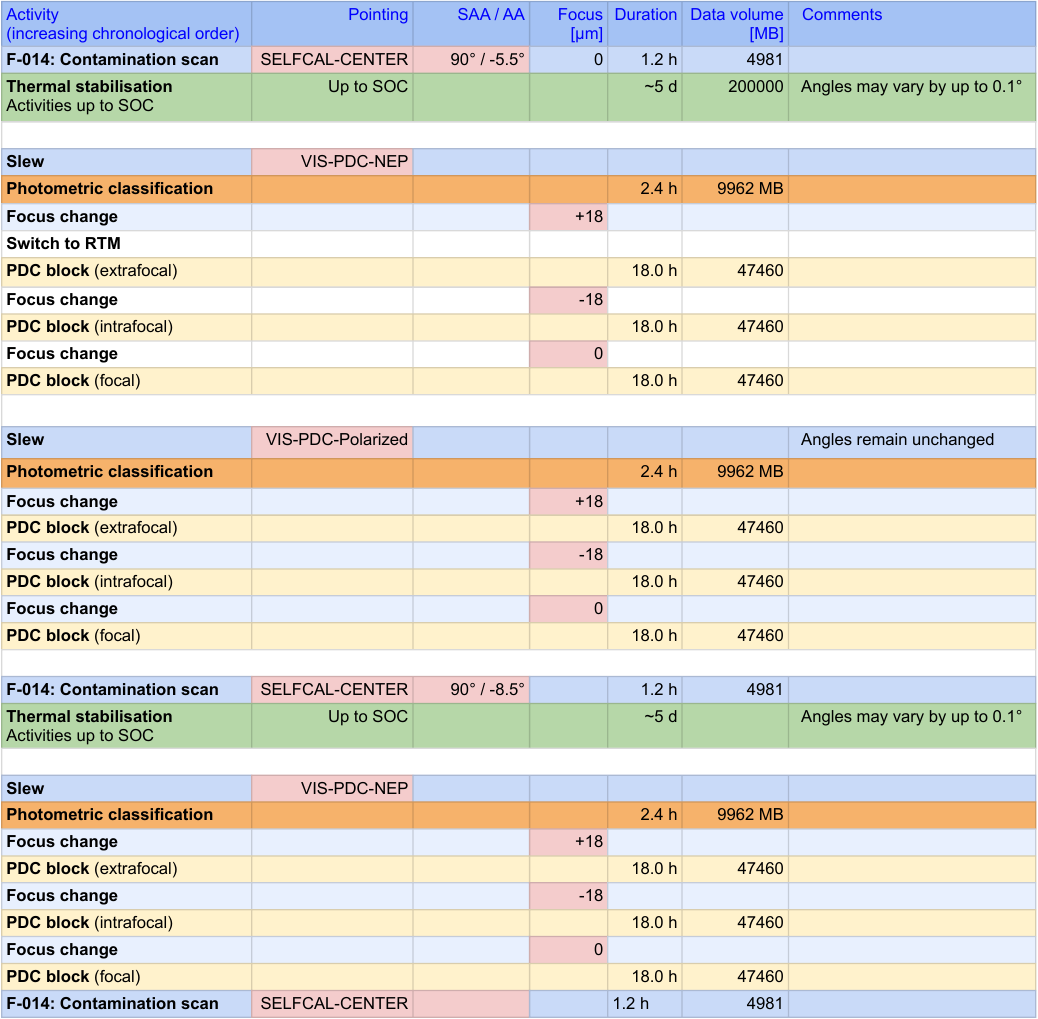
Figure 12: Baseline for the defocused PDC observations. Green areas show thermal stabilisation times. Yellow fields are the actual PDC observations. Red fields show changes in attitude or pointing.
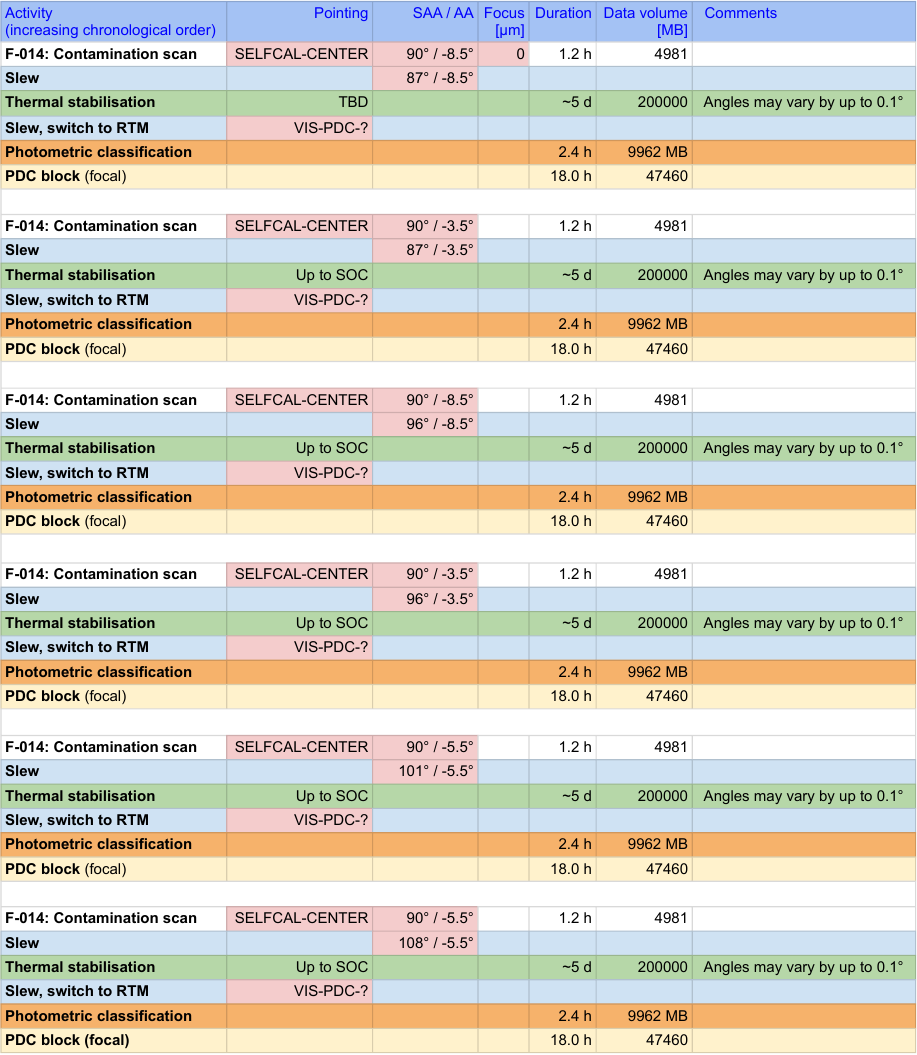
Figure 13: Baseline for the in-focus PSF observations. Green areas show thermal stabilisation times. Yellow fields are the actual PDC observations. Red fields show changes in attitude or pointing. The fields will be chosen by OU-SHE.
Fulfilling
Targets and pointing constraints
Pointing: Thermal stabilization is required during which SAA and AA must be kept stable to within 0.1 degrees. Small changes within an individual exposure due to orbit progression are permissible. The field choice is constrained by launch-time and the desired SAA. In case of an “attidue hold mode” or AHM, the spacecraft must maintain its current attitude to not destroy the thermal equilibium.
#ID |
R.A. |
Dec |
ELON |
ELAT |
GLON |
GLAT |
Comment |
NEP |
268.75 |
65.80 |
235.86 |
89.09 |
95.51 |
30.32 |
|
Polarized |
328.00 |
70.76 |
37.62 |
69.34 |
109.14 |
12.86 |
|
VIS-PDC-1 |
292.48 |
53.53 |
321.00 |
73.00 |
85.33 |
16.16 |
|
VIS-PDC-2 |
285.03 |
49.83 |
302.00 |
71.60 |
79.93 |
19.07 |
|
VIS-PDC-3 |
275.78 |
47.80 |
282.00 |
71.00 |
75.93 |
24.30 |
|
VIS-PDC-4 |
265.72 |
48.09 |
261.00 |
71.40 |
74.83 |
30.97 |
|
VIS-PDC-5 |
254.20 |
49.37 |
237.00 |
71.00 |
75.94 |
38.61 |
|
VIS-PDC-6 |
247.27 |
52.69 |
220.00 |
72.20 |
80.91 |
42.58 |
in-focus only |
VIS-PDC-7 |
239.80 |
56.89 |
200.00 |
73.00 |
88.18 |
45.55 |
in-focus only |
VIS-PDC-8 |
235.16 |
60.85 |
184.00 |
73.80 |
94.79 |
45.96 |
in-focus only |
VIS-PDC-9 |
225.35 |
61.91 |
172.50 |
70.50 |
100.21 |
49.09 |
in-focus only |
VIS-PDC-10 |
221.47 |
67.43 |
155.00 |
71.50 |
107.55 |
46.13 |
|
VIS-PDC-11 |
215.61 |
73.55 |
135.00 |
71.00 |
114.45 |
42.05 |
|
VIS-PDC-12 |
– |
– |
– |
– |
– |
– |
Too far North for EXT |
VIS-PDC-13 |
43.34 |
-66.36 |
339.00 |
-71.80 |
285.75 |
-46.49 |
|
VIS-PDC-14 |
45.21 |
-61.46 |
353.50 |
-70.20 |
279.78 |
-49.44 |
in-focus only |
VIS-PDC-15 |
54.60 |
-58.77 |
9.00 |
-72.30 |
272.38 |
-47.24 |
|
VIS-PDC-16 |
59.25 |
-55.16 |
23.00 |
-71.50 |
266.02 |
-46.46 |
|
VIS-PDC-17 |
65.30 |
-51.89 |
38.00 |
-70.90 |
260.15 |
-43.91 |
|
VIS-PDC-18 |
73.52 |
-49.10 |
56.00 |
-70.60 |
255.62 |
-39.06 |
|
VIS-PDC-19 |
81.34 |
-48.10 |
72.00 |
-71.00 |
254.49 |
-33.88 |
|
VIS-PDC-20 |
63.55 |
-49.19 |
39.00 |
-68.00 |
256.73 |
-45.53 |
in-focus only |
VIS-PDC-21 |
185.90 |
78.10 |
119.02 |
64.98 |
124.77 |
38.93 |
|
VIS-PDC-22 |
150.00 |
78.50 |
109.74 |
59.25 |
132.49 |
35.23 |
|
VIS-PDC-23 |
87.60 |
-47.50 |
85.04 |
-70.90 |
254.36 |
-29.63 |
|
VIS-PDC-24 |
265.07 |
71.35 |
108.00 |
84.90 |
102.06 |
31.26 |
Instrument configuration
Instrument: Special. Requires M2M movements (defocusing).
Methodology / Uplink procedure
Entity: NISP
Commanding Method: NISP: Observation
Dither Sequence: 150 dithers in a 100” diameter circular pattern. The 8 ROS_D1 dithers are also dithered on the same 100” diameter circle, evenly spaced, so that NISP coverage is maximised for the full area.
Inter-operability constraints
VS-CU off
In-orbit duration
In-orbit Duration:
2nd - 4th SAA/AA points: 8-13 days each (5-10 days stabilization)
5th - 10th SAA/AA points: 6-11 days each (5-10 days stabilization)
Total time, assuming a 10 day thermal stabilization period: 105 days
Total time, assuming a 5 day thermal stabilization period: 60 days
Data volume
2nd to 4th point: 900000 MB
5-th to 10-th point: 580000 MB
Processing input
Ground Processing Input Data: TBD
Data Description: TBD
Processing method
TBD
Processing output
PSF model
Required accuracy, constraints
TBD
Validation
VIS: The analysis of the phase diversity data is a substantial manual off-line task done by OU-SHE, and the validation / success criteria are not available at this time. Results are expected only once we are well into the routine phase observations, at which point a phase diversity campaign will not be repeated lightly.
Quality control parameters
DataModel: https://gitlab.euclid-sgs.uk/
Contact person
Calibration Lead