CALBLOCK-PV-003: NISP-S Absolute Photometric Standards
Observation configuration file
Scheduling
Once. The targets might not be visible during PV phase, and must be observed at a suitable time offering minimum spectra-order contamination.
In case of failure, repeat as soon as possible due to limited visibility.
Time-critical
Yes. Observations must be taken when the individual grism spectra of that star are not contaminated by other sources.
Objective
Obtain measurements of a HST CALSPEC spectro-photometric standard star as a function of position for each NISP detector and grism.
Observations
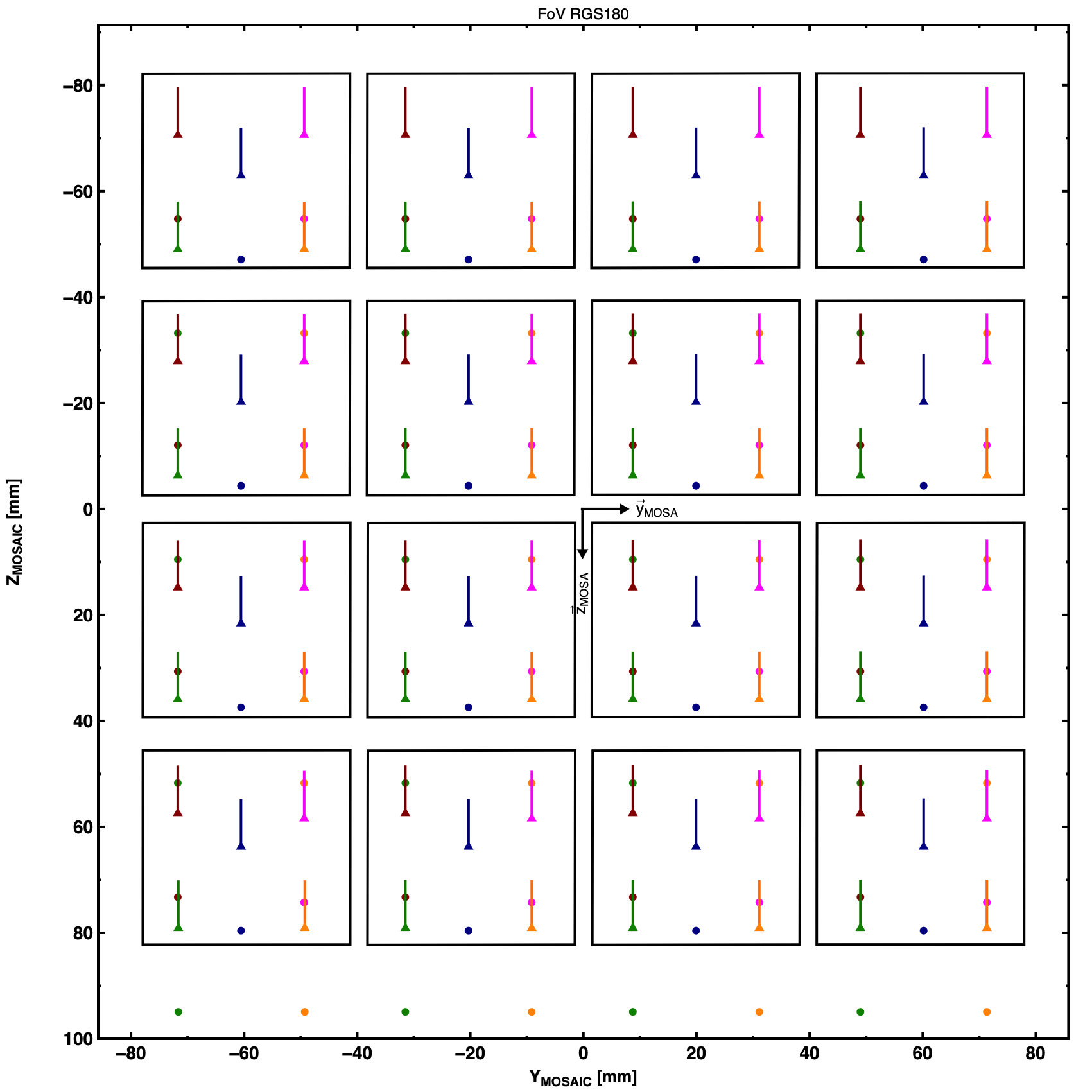
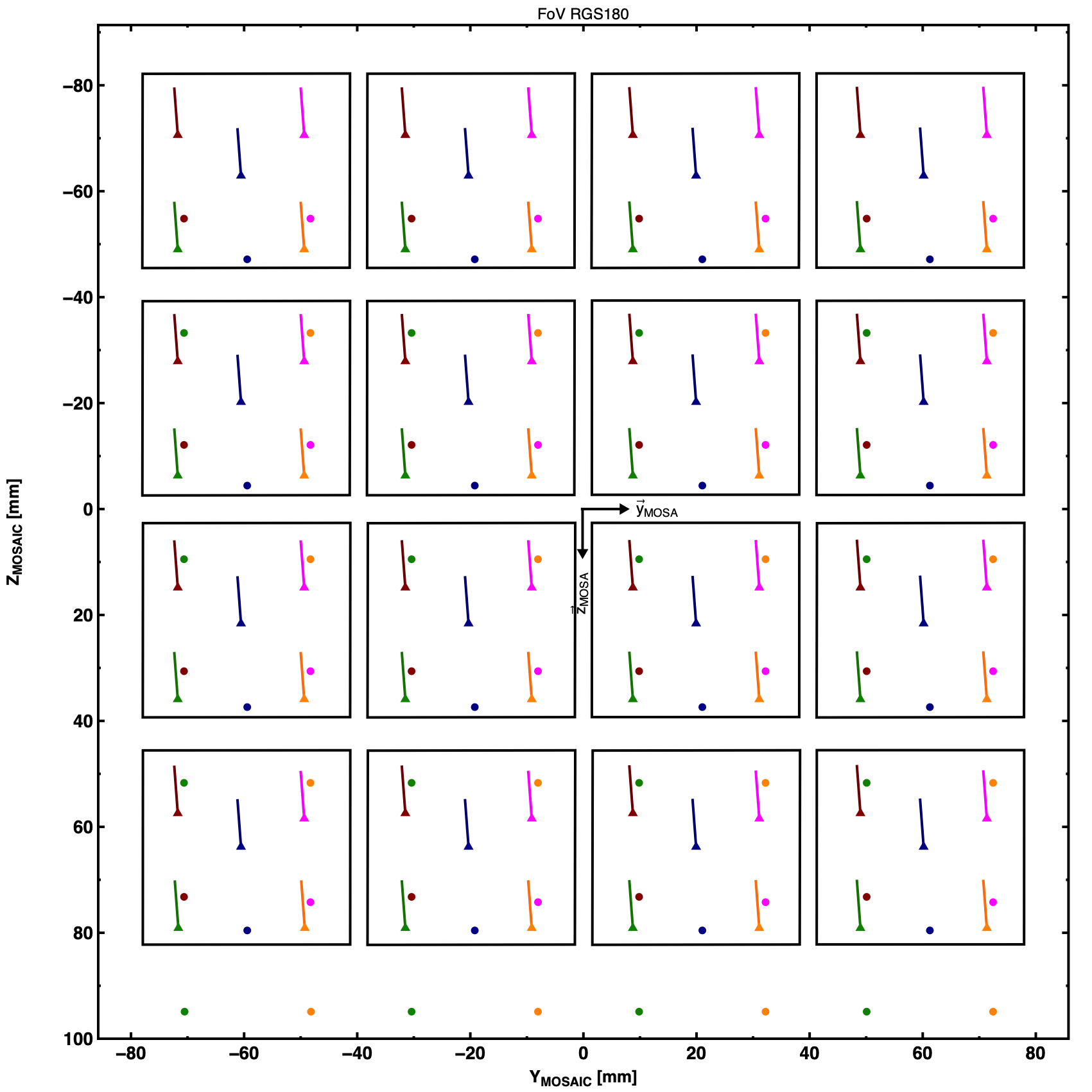
The star is stepped across 5 positions on each detector. A NISP-S spectro-MACC exposure is taken at each position, observed with each grism. Since self-consistent catalogs require imaging data as well, the ROS_D1 is executed at each dither position.
An accurate position is required for the star for the wavelength solution. The star will be saturated in NISP images, such that OU-MER must replace the NISP-P position with the expected Gaia position for that epoch of observation.
Spectra contamination is critical, i.e. each grism must be scheduled at suitable times. This introduces a considerable launch-time dependency, as suitable targets have limited visibility.
The ROS_D1 VIS variants are mostly NominalScience+ShortScience [NS+SS], with cases of [NS+Bias] distributed once every 6 to 8 hours. The biases provide instrumental reference. The Short Science exposures are not mandatory, but useful for VIS photometric and astrometric calibration of the NISP target.
for grism in [RGS000, RGS000_rot, RGS180, RGS180_rot, BGS000]:
    for offset in dither_offsets:
        if visible without contamination:
             ROS_<grism>
        else:
             schedule <grism> at another time
Fulfilling
Targets and pointing constraints
Pointing: VIS straylight supression: \({\rm AA}\leq-3.5\). Scheduling must verify that no considerable order-overlap occurs for the first order. This can tightly constrain the times at which a particular grism can be calibrated.
# ID |
R.A. |
Dec |
Type |
J [AB mag] |
H [AB mag] |
comment |
GRW+70 |
13:38:49.21 |
+70:17:07.25 |
DA2.4 |
14.1 |
14.7 |
ICRS 2016.0; pmra=402.079 pmdec=-24.556 |
GD153 |
12:57:02.32 |
+22:01:52.63 |
DA1.2 |
14.9 |
15.6 |
|
GD71 |
05:52:27.62 |
+15:53:13.23 |
DA1.5 |
14.6 |
15.3 |
DO NOT USE; crowded |
WD1057+719 |
11:00:34.24 |
+71:38:02.92 |
DA1.2 |
15.4 |
17.0 |
DO NOT USE; crowded |
KF06T2 |
17:58:37.99 |
+66:46:52.11 |
K1.5III |
12.8 |
12.5 |
DO NOT USE; crowded; too bright |
# ID |
Visibility |
|
GRW+70 |
2023-03-15 => 2023-05-22 |
2023-11-04 => 2024-01-09 |
GD153 |
2023-06-03 => 2023-06-30 |
2023-12-22 => 2024-01-15 |
GD71 |
2023-02-28 => 2023-03-23 |
2023-09-17 => 2023-10-11 |
WD1057+719 |
2023-03-18 => 2023-05-01 |
2023-10-20 => 2023-12-03 |
KF06T2 |
perennial |
Instrument configuration
Instrument: Wide survey
Methodology / Uplink procedure
Entity: VIS & NISP
Commanding Method: NISP: Observation, VIS: Science
Dither Sequence: ROS_RGS000, ROS_RGS000_rot, ROS_RGS180, ROS_RGS180_rot, ROS_BGS000
The dither offsets are as follows:
|
|
|
|
|
|
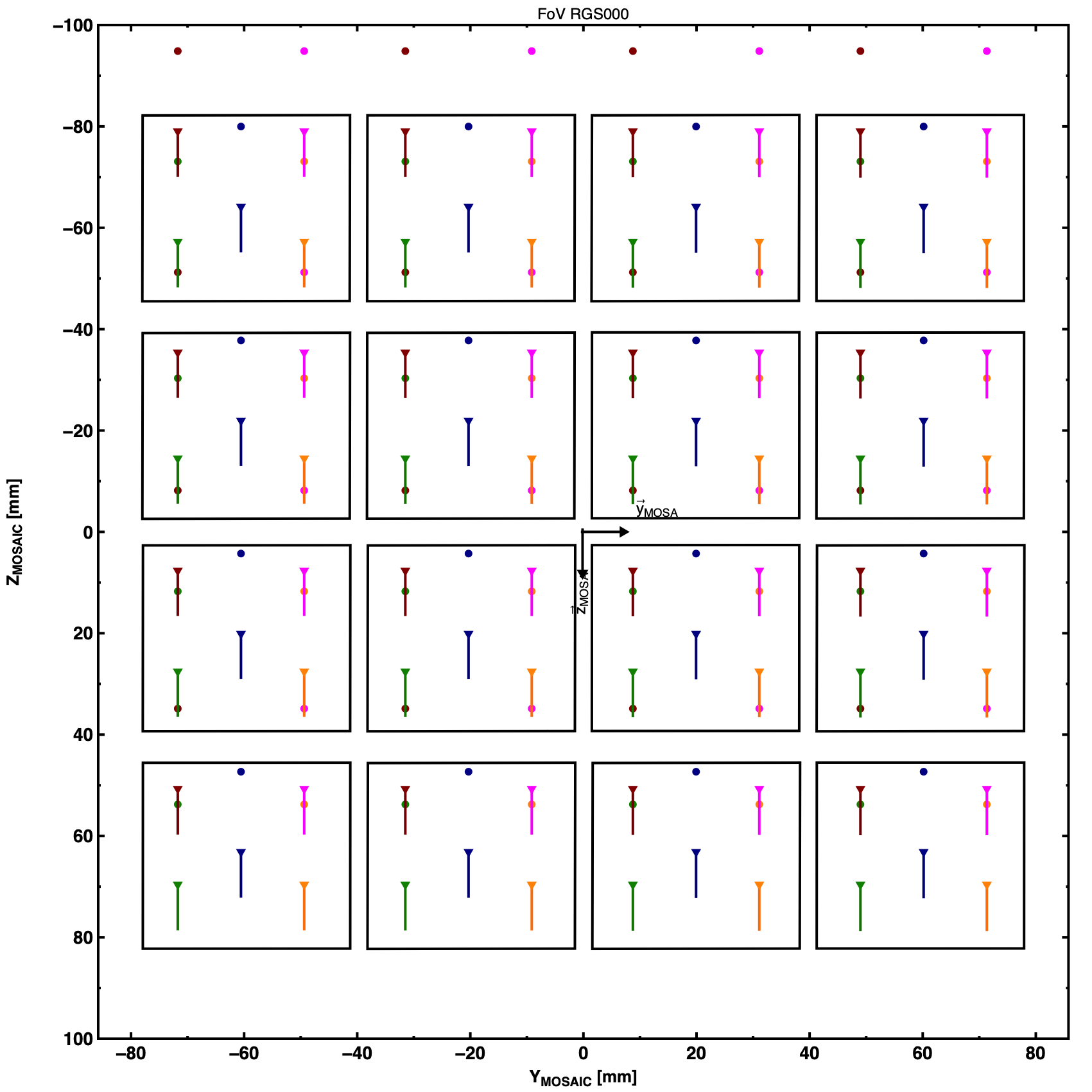
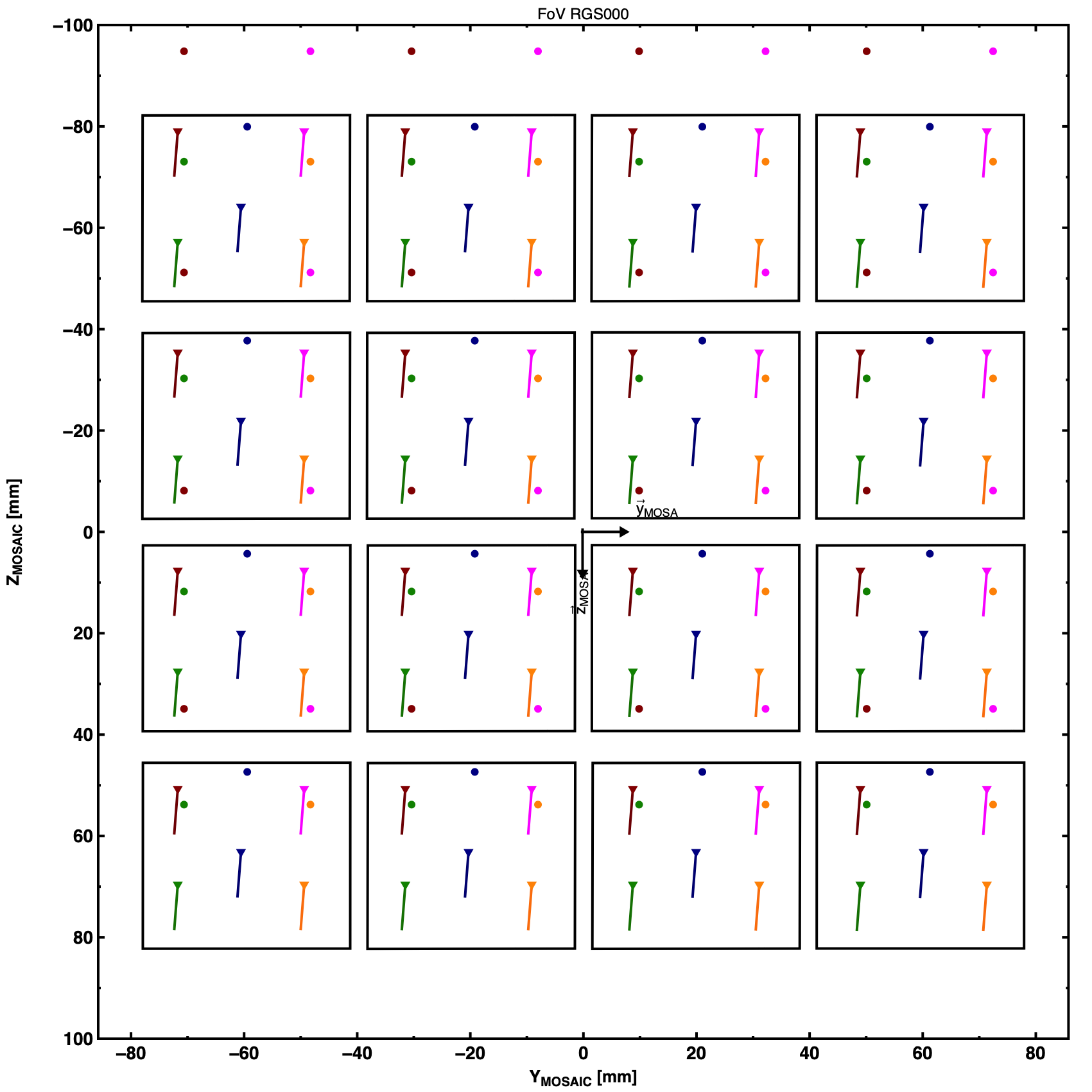
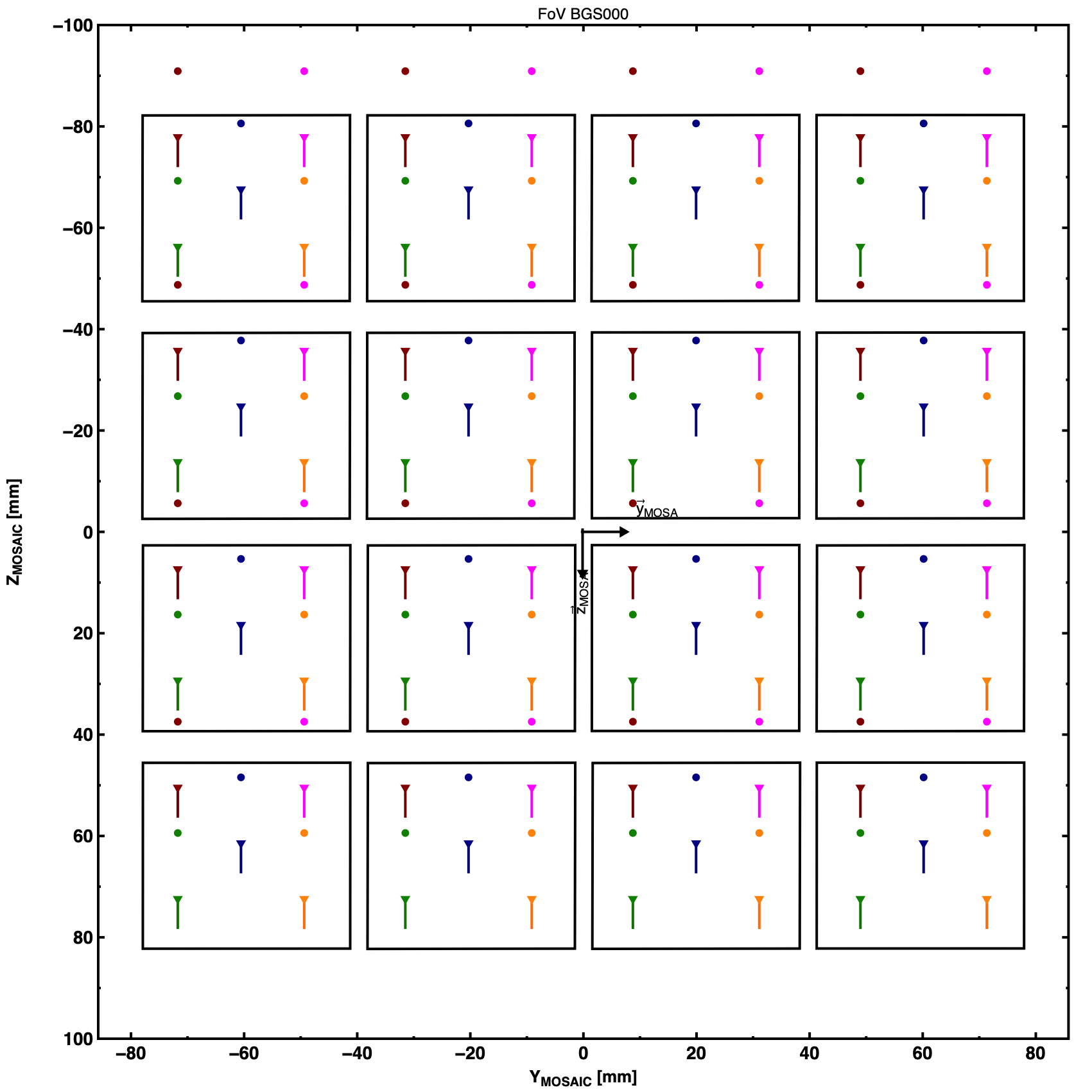
RGS000 dither offset (also for the rotated position)
RGS180 dither offset (also for the rotated position)
Inter-operability constraints
None
In-orbit duration
In-orbit Duration: 122.3 h
80*5 = 400 executions of a ROS_D1-like observation
Data volume
400*ROSD1 = 521200 MB
Processing input
Ground Processing Input Data: All calibration products to run the standard science pipeline (BPM, darks, flat, nonlinearity, etc), reference measurement of standard star, RSR curves (relative spectral response of the system (mirrors, optics, instrument)
Data Description:
Processing output
Absolute spectro-photometric transmission as a function of source position in the focal plane.
Required accuracy, constraints
The measured spectro-photometric response is within the expectations from the known system transmission and detector QE curves.
Processing tools
L1 science pipeline and absolute calibration pipeline, additional offline trend analysis of flux measurements
Quality control parameters
DataModel: https://gitlab.euclid-sgs.uk/
Contact person
NISP-S calibration scientist