CALBLOCK-PV-004: Internal straylight check
Observation configuration file
Scheduling
Once, during PV phase.
In case of failure, repeat at next possible opportunity.
Time-critical
No.
Dependencies
None.
Objective
The objective of these observations is to quantify / test for two different types of straylight.
Glint check:
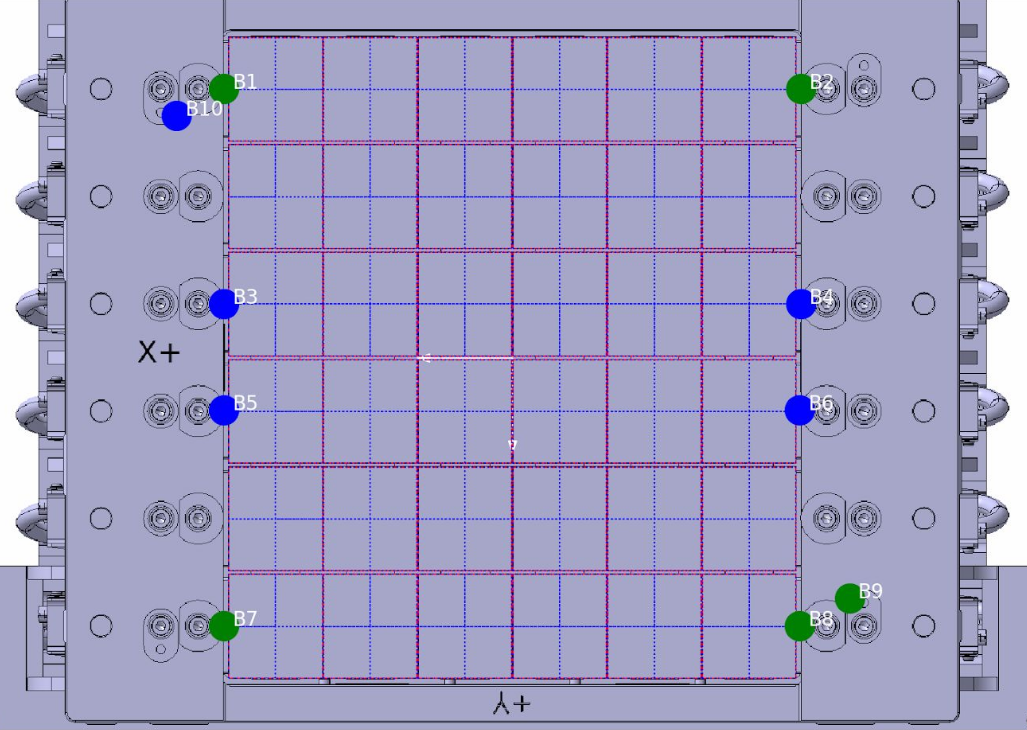
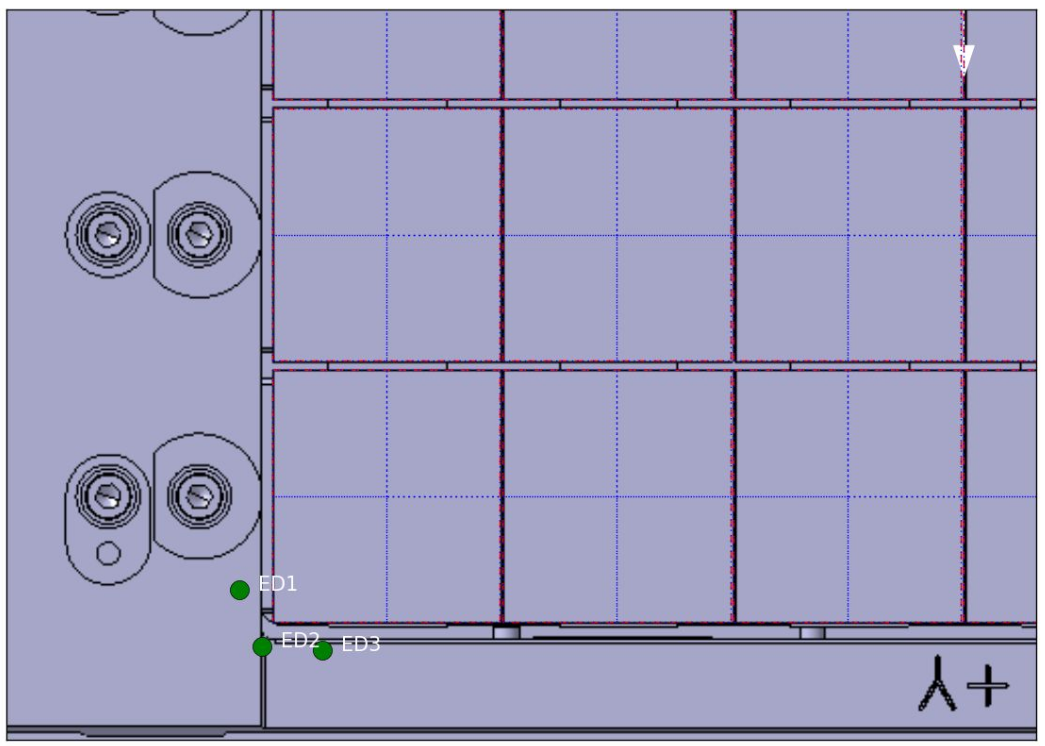
These are parasitic reflections caused by mechanical features within or near the detector focal planes, such as detector edges or bolt hoods. We want to test whether these mechanical features can cause specific glints, and also study their appearance in the images. Like this, we can understand their origin if encountered in survey images. Once we have sufficient amounts of survey data, we could in principle build a glint model if necessary, and provide a masking functionality. The edge of the VIS shutter blade is known as a glint source from the ground-based PLM tests.
NDI check:
The NDI (normalized detector irradiance) describes the unbaffeled scattered / parasitic light reaching the focal plane from in-field and out-of-field sources. It is controlled by the baffles, scattering of non-optical surfaces, as well as micro-roughness, particulate and molecular contamination of optical surfaces. Particulate and molecular contamination are subject to change during launch and in space, and therefore the NDI model could vary over time. The objective is to establish whether the NDI determined on ground is still adequate for very bright out-of-field sources, because this model determines the bright star avoidance radius implemented in the survey. This check is not meant to provide data for a completely new NDI model.
Observations
Glint check:
Dither positions (VIS FPA coordinates)
The observations are driven by VIS. A medium bright star (~6 AB mag) is placed on several locations immediately adjacent to the focal plane. At each position the ROS_D1 is executed. The pointing accuracy is determined by the AOCS. The related uncertainty is smaller than the physical size of mechanical features, and thus of no concern.
The ROS_D1 VIS variants are mostly NominalScience+ShortScience [NS+SS], with [NS+Bias] at the beginning, middle and the end of the CALBLOCK. The biases provide instrumental reference. The SS exposures are not mandatory.
|
|
NDI check:
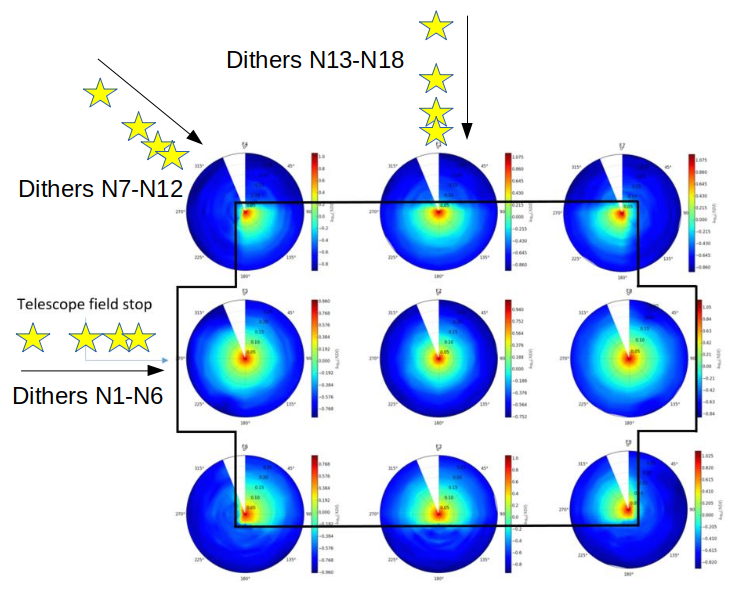
Dither positions (VIS FPA coordinates)
Place a very bright star (0-2 AB mag) at increasingly smaller separations from the focal plane, with a logarithmic decrease of the step width:
separation = 240, 120, 60, 30, 15, 10 arcmin
These are the distances from the focal plane edge (corner), when approaching the edge (corner). Three different approach directions are needed, driven by the telescope baffle. Do not step closer than 10’ to the edge / corner of the FPA. Execute the ROS_D1 at each pointing.
Fulfilling
Targets and pointing constraints
Pointing: No angle constraints
Glint check:
# ID |
R.A. [Gaia DR2] |
Dec [Gaia DR2] |
pmRA [mas/yr] |
pmDEC [mas/yr] |
r [AB] |
i [AB] |
z [AB] |
J [AB] |
H [AB] |
HD 165906 |
270.88226121 |
64.86423345 |
-13.15 |
-1.30 |
7.25 |
6.95 |
6.77 |
6.48 |
6.39 |
NDI check:
# ID |
R.A. |
Dec |
V |
J |
H |
Ks |
Type |
Gamma_Dra |
269.151541 |
51.488896 |
2.19 |
0.47 |
0.36 |
0.50 |
K5 |
Alpha_Eri |
24.428512 |
-57.236649 |
0.42 |
1.72 |
2.25 |
2.73 |
B3 |
Alpha_Per |
51.080677 |
49.861149 |
1.75 |
1.74 |
1.80 |
2.37 |
F5 |
Alpha_Tau |
68.980174 |
16.509201 |
0.81 |
-1.18 |
-1.38 |
-1.19 |
K5 |
Alpha_Aur |
79.172432 |
45.997925 |
0.04 |
-0.33 |
-0.18 |
0.11 |
G5 |
Beta_Ori |
78.634450 |
-8.201676 |
0.08 |
1.11 |
1.56 |
2.06 |
B8 |
Alpha_Ori |
88.792856 |
7.407109 |
0.46 |
-2.07 |
-2.61 |
-2.52 |
M1 |
Alpha_Car |
95.987890 |
-52.695599 |
-0.76 |
-0.25 |
0.11 |
0.54 |
F0 |
Alpha_CMa |
101.286999 |
-16.715742 |
-1.50 |
-0.48 |
-0.00 |
0.46 |
A1 |
Alpha_CMi |
114.825230 |
5.224955 |
0.34 |
0.41 |
0.72 |
1.19 |
F5 |
Beta_Gem |
116.328824 |
28.026127 |
1.10 |
0.59 |
0.54 |
0.91 |
K0 |
Alpha_UMa |
165.931874 |
61.750954 |
1.75 |
0.57 |
0.63 |
1.02 |
K0 |
Gamma_Cru |
187.791408 |
-57.113186 |
1.59 |
-1.08 |
-1.59 |
-1.40 |
M3 |
Alpha_Boo |
213.915334 |
19.182194 |
-0.08 |
-1.34 |
-1.42 |
-1.06 |
K1 |
Alpha_Sco |
247.351820 |
-26.431938 |
0.92 |
-1.94 |
-2.33 |
-2.25 |
M1 |
Alpha_Lyr |
279.234723 |
38.783691 |
-0.01 |
0.73 |
1.36 |
1.97 |
A0 |
Alpha_Aql |
297.695778 |
8.868339 |
0.73 |
1.22 |
1.49 |
1.95 |
A7 |
Instrument configuration
Instrument: Wide survey
Methodology / Uplink procedure
Entity: NISP, VIS
Commanding Method: VIS: Science, NISP: Observation
Dither Sequence: ROS_D1 at every pointing
Dither positions are provided in the VI-FPA-DP URF system, defined in the VIS FPA Interface Control Document (ICD; EUCL-SAP-ICD-6-001).
Inter-operability constraints
None.
In-orbit duration
In-orbit Duration: 10.3 h (31 executions of the ROS_D1)
Data volume
31*ROSD1 = 40393 MB
Processing input
Ground Processing Input Data: 31 VIS images, 93 NISP-P images (31 in each filter) and 31 NISP-S spectra (can be ignored)
Data Description:
Processing method
With the astrometric solution and the bright star coordinates known, determine the position of the bright star in the VIS and NISP FPA coordinate systems. Identify any specific locations that might trigger glints or reflections. Should glints be a common issue, then we need to build glint models, which can be done after some time using nominal survey data.
For the NDI check, determine the local background value in the VIS and NISP images, and compare with the NDI forecast.
Processing output
A set of viewgraphs depicting typical straylight features (if any) caused by detector edges and bolts.
Plots comparing the observed VIS and NISP NDI with the respective forecasts. If necessary, the bright star avoidance radius must be adjusted accordingly by EC-SURV.
Required accuracy, constraints
Stars must be sufficiently bright to cause enough signal-to-noise for the detetcion of glints, and straight-forward measurement of the NDI.
Processing tools
Single-frame processing including astrometric calibration (L1?)
Validation
The extended PSF and scattered light must be low enough such that the position of the ghost can be measured accurately. The ghost must not be superimposed over another bright star (the target fields are chosen accordingly).
Recovery
A repetition of the observations is only foreseen in case of a technical issues during the observation sequence.
Quality control parameters
DataModel: https://gitlab.euclid-sgs.uk/
Contact person
Calibration Lead