CALBLOCK-PV-023: VIS Astrometric Solution
Observation configuration file
Scheduling
Once during PV phase.
In case of failure, repeat at next possible opportunity. Should ideally be executed prior to CALBLOCK-PV-001: Self Calibration, but the latter should not be delayed in case of failure.
Time-critical
Yes, must be executed before the first run of CALBLOCK-PV-001: Self Calibration.
Objective
These observations have three goals.
Determine the relative stitch block alignment for each CCD. The stitch blocks have sizes of \(256*512\) pixel, i.e. there are 128 stitch blocks per detector. The CCD is formed by projecting stitch block matrices onto the waver using photolitography. The alignment is not perfect, and can be accurately determined using absolute GAIA reference sources. To this end we need at least 10 stars per stitch block (scale, shift, rotation). With a stellar density of 1000 stars per detector we would have about 8 stars per stitch block. Shot noise will make this number lower for some stitch blocks, hence dithered observations are required. The stitch blocks are part of the crystalline structure of the CCD and will not change their relative orientation during the mission. Their positions need to be measured only once.
Determine the relative detector positions and orientations, including any other terms that can be described as a linear mapping (e.g. shear, flip). Relative detector orientations are subject to change and must be monitored regularly; they are given in the absolute VIS FPA coordinate system.
Determine the optical distortion with high angular resolution (on arcmin scales). The distortions manifest as a change of the FPA’s plate scale. To this end, during PV phase, VIS needs at least 1000-2000 GAIA unsaturated (fainter than V=17.5 AB mag) reference sources per detector, i.e. a stellar density of 25 stars per square arcmin or more. Such densities are only reached in the galactic plane or the LMC (the self-cal field offers 1.2 such reference source per square arcmin), and is also sufficient for the stitch block measurement. The optical distortion is expected to be stable over time.
The data are not specifically useful for the NISP optical distortion, as the NISP filters have optical power and move in and out of the beam.
Observations
Execute the ROS_D1 20 times with random dithers on a dense stellar field. The number of dithers increases the effective stellar number density, and / or provides independent data for verification.
Fulfilling
Targets and pointing constraints
Pointing: Straylight suppression as per MOCDA-SYS-003.
A high density stellar field is required for the optical distortion, yielding \(20-50\;{\rm arcmin^{-2}}\) GAIA references
# ID |
R.A. |
Dec |
VIS-AST-1 |
90.000 |
-66.500 |
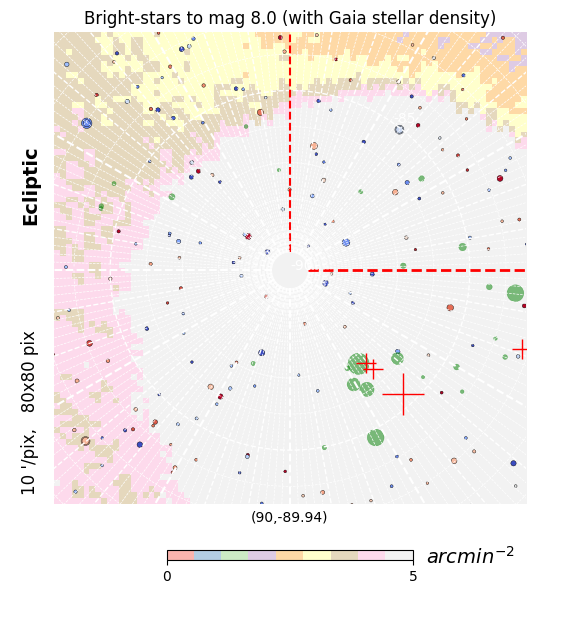
Figure: Gaia-DR2 stellar density (down to 17 mag) for the VIS astrometric field near the LMC. The DR3 density down to 20 and 21 mag is 15 and 35 \({\rm arcmin}^{-2}\), respectively.
Instrument configuration
Instrument: VIS
Methodology / Uplink procedure
Entity: VIS
Commanding Method: VIS science
Dither Sequence: ROS_D1, random dither offsets in a 3’ box
Inter-operability constraints
None
In-orbit duration
In-orbit Duration: 6.0 h (5 executions of the ROS)
Data volume
5*ROS = 24905 MB
Processing input
Ground Processing Input Data: All calibration products to run the standard science pipeline (BPM, darks, flat, nonlinearity etc), astrometric reference catalog (Gaia), offline analysis
Data Description:
Processing method
Match the centroids of isolated stellar sources against the GAIA reference catalog, correcting the latter for the proper motion offsets accumulated since the GAIA reference epoch to the time of observation.
Processing output
Distortion map of the VIS focal plane
Relative detector positions and orientations
Monthly evaluation of the absolute detector position and rotation in the VIS FPA coordinate system.
Vector plots showing how the detectors drift and rotate over time
Required accuracy, constraints
Accurate (TBD) source position measurements
Processing tools
Pipeline: VIS_AstrometryCalibration
PE: VIS_Astrometry
Quality control parameters
DataModel: https://gitlab.euclid-sgs.uk/
Contact person
VIS instrument scientist