CALBLOCK-PV-001: Self Calibration
Observation configuration file
Scheduling
Execute 4 times during PV phase.
In case of failure, repeat as soon as possible.
Time-critical
One of the four visits must be executed a soon as possible during PV. The other visits are ideally separated by at least 7 days.
Dependencies
CALBLOCK-PV-023: VIS Astrometric Solution must be executed once, before the first execution of this CalBlock.
Objective
These observations provide the baseline to monitor Euclid’s spectrophotometric response to space weathering and outgassing. This is achieved by multiple dithered exposures of the Self-cal field.
During PV phase, the Self-cal sequence is executed four times, (1) to verify that it is working, (2) to provide tight initial monitoring of system parameters and important calibration products, (3) to monitor for contamination effects, and (4) to calibrate the grisms’ large-scale flats. The RGS270 is excluded and will be calibrated only if necessary.
Observations
Execute the ROS_D1 with a specific grism, at each of 60 pointings
A total of 4 self-cal visits is required to observe all grisms at all 60 dithers
BGS observations require \({\rm AA}\) offsets of at least \(\pm1.4\) to facilitate spectra-order decontamination, better \(\pm2.0\). Whether the negative or positive offset is executed first does not matter.
The grism order must be preserved as outlined in the pseudo-code, as it can be executed any time without violating slew constraints.
\({\rm AA}\) may vary during a visit due to orbit progression
While \({\rm AA}\) can be chosen in principle freely within \([-7.5,-3.5]\) to minimise thermal transients and meet VIS straylight requirements, we enforce \({\rm AA}=-5.5\) to ensure that the limits are not violated by the bracketing BGS observations.
The illumination-correction maps for the VIS and NISP imaging channels can exploit the additional, rotated blue-grism dithers, bringing the total from 60 to 76 exposures.
Note the rolling order of the red grisms in the 4 visits
The blue grism repeats 4 central dithers at the end of the 4th configuration
The ROS_D1 VIS variants are mostly NominalScience+ShortScience [NS+SS] (72 pointings), with 4 cases of [NS+Bias] distributed evenly. The 4 biases provide instrumental reference; each Self-cal visit starts and ends with the [NS+Bias] variant of the ROS_D1. The Short Science exposures are required for VIS absolute photometric calibration.
ma = -5.5  (chosen AA angle for red-grism observations)

Set AA = ma-2
   Dithers 42, 44, 45, 48, 2, 3, 30, 32: BGS000
Set AA = ma
   Execute 60 dithers as specified, red-grism order: RGS000, RGS180_rot, RGS000_rot, RGS180, repeat
Set AA = ma+2
   Dithers 41, 43, 47, 46, 1, 4, 29, 31: BGS000
Set AA = ma-2
   Dithers 53, 54, 49, 50, 37, 39, 26, 25: BGS000
Set AA = ma
   Execute 60 dithers as specified, red-grism order: RGS180_rot, RGS000_rot, RGS180, RGS000, repeat
Set AA = ma+2
   Dithers 56, 55, 51, 52, 38, 40, 28, 27: BGS000
Set AA = ma-2
   Dithers 10, 11, 5, 7, 23, 21, 18, 19: BGS000
Set AA = ma
   Execute 60 dithers as specified, red-grism order: RGS000_rot, RGS180, RGS000, RGS180_rot, repeat
Set AA = ma+2
   Dithers 9, 12, 6, 8, 22, 24, 17, 20: BGS000
Set AA = ma-2
   Dithers 13, 14, 33, 36, 57, 58, 41, 42: BGS000
Set AA = ma
   Execute 60 dithers as specified, red-grism order: RGS180, RGS000, RGS180_rot, RGS000_rot, repeat
Set AA = ma+2
   Dithers 16, 15, 34, 35, 59, 60, 43, 44: BGS000
Fulfilling
Targets and pointing constraints
Pointing: Straylight suppression: \({\rm AA}=-5.5\) for the red-grism pointings. They must be executed in the order given in CSV file. The 16 dithers for the blue grism use two different \({\rm AA}\).
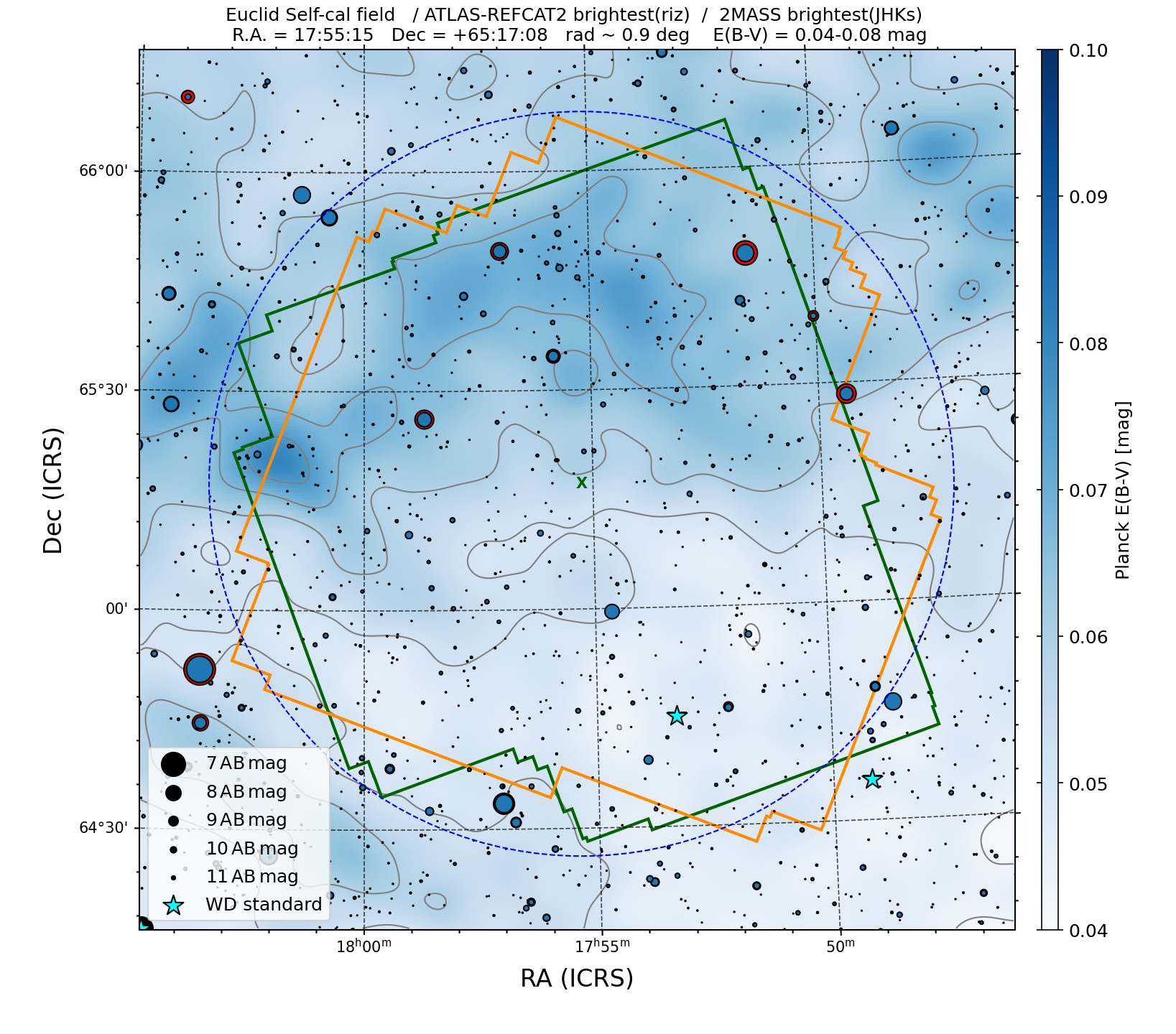
Figure 14: The Self-cal field is located near the NEP. It includes a hot White Dwarf (blue asterisk) for CALBLOCK-PV-002: NISP-P and VIS Absolute Photometric Standards. The green and orange outlines show the boundaries for visits at two different times, where orbit progression results in boundary rotation.
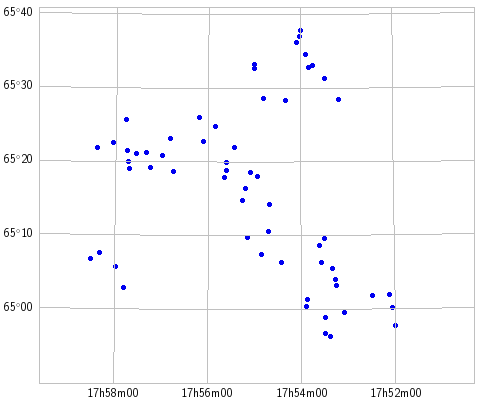
Figure 15: Self-cal dither pattern. Observations must step through the dithers as specified in this CSV file
# ID |
R.A. |
Dec |
SELFCAL-CENTER |
268.812745 |
65.2855857 |
Instrument configuration
Instrument: Wide survey
Methodology / Uplink procedure
Entity: VIS & NISP
Commanding Method: NISP: Observation, VIS: Science
Dither Sequence: ROS_D1.
The ROS_D1 is executed at each of these Self-cal dither positions. The order in which they are executed does not matter, within a fixed \({\rm AA}\) setting. The grism to be used at a specific dither is given in the observations.
Inter-operability constraints
None
In-orbit duration
In-orbit Duration: 94.0 h
Each visit takes approximately 23.5 h.
Data volume
76*ROSD1 = 99028 MB per visit
Processing input
Ground Processing Input Data: All calibration products to run the standard science pipeline (BPM, darks, flat, nonlinearity etc), small scale flat fields
Data Description: Each visit provides: 225 photo-MACC images, 76 spectro-MACC images, 76 VIS nominal science, and 76 VIS short science exposures.
Processing output
Large scale flat field for VIS and all NISP filters and grisms
NISP-S dispersion check using secondary wavelength calibrators
Absolute photometric zeropoint for VIS and NISP.
Coarsely binned (e.g. 100x100) illumination correction map, and monitoring
VIS and NISP focal plane astrometric solutions
Monitoring of system parameters
Required accuracy, constraints
Images successfully acquired
Processing tools
Pipeline: VIS_LargeFlatCalibration_Pipeline
PE: VIS_LargeFlatCalibration
Quality control parameters
DataModel: https://gitlab.euclid-sgs.uk/
Contact person
Calibration Lead