CALPRODUCT-NI-010: NISP LED Flats
Parent requirement
Scheduling
PV phase (10, 20, 30, 40, 50 kADU)
Monthly (30 kADU fluence, only)
Time-critical
No
Objective
Obtain NISP LED flats for all 5 LEDs. They form the basis to correct the small-scale features and pixel-to-pixel response non-uniformity (PRNU) in the photometric and spectroscopic data (CALPRODUCT-NP-009: NISP-P Small-Scale Flat and CALPRODUCT-NS-005: NISP-S Small-Scale Flat), and to characterize CALPRODUCT-NI-003: NISP Brighter-fatter Effect.
In flight, we will probably need less fluences on a monthly basis. During PV phase, 5 different fluences will be taken to also characterize the brighter-fatter effect.
Fulfilled by
CALBLOCK-PV-010: NISP LED flats
CALBLOCK-F-007: VIS Nonlinearity, PTC, BFE and NISP LED flats
Data volume
750*NP (flats) + 30*NS (spectro-MACC darks) = 70380 MB. The darks are not needed for the analysis.
Processing input
Ground Processing Input Data: BPM, photo-MACC master dark, nonlinearity calibration correction, ground-based QE, ground-based fine wavelength grid flats
Data Description: 750 photo-MACC images (5 LEDs, 5 fluences, 30 exposures per setting)
Processing method
Compute the mean (or median) flux level per exposure and detector. Identify the n-th exposure, after which the flux does not change significantly anymore (burn-in achieved). Perform a median-combination using outlier rejection (masking of cosmics) for each LED fluence setting.
Processing output
Normalized combined flat fields for each LED, trend analysis.
Processing tools
L1 small scale flat pipeline, trending statistics, offline analysis for trapping/de-trapping, persistence,
Validation
The LED flats must not have structures on scales of 100 pixels or below
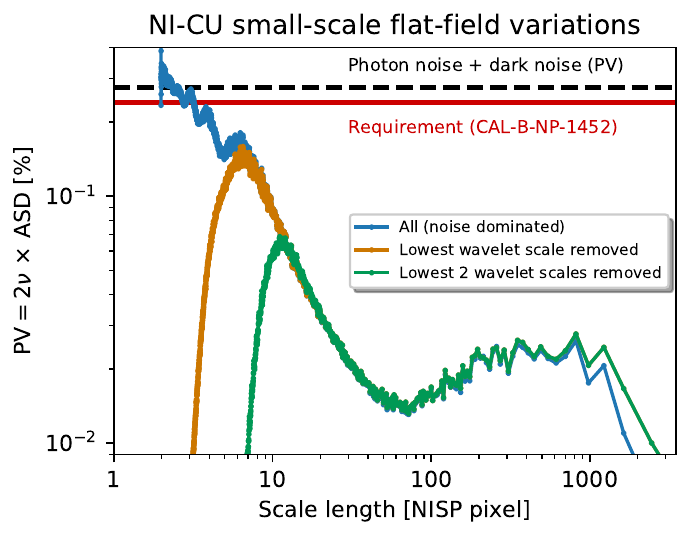
Figure 5: Amplitude spectral density of the NI-CU verification model. The spectrum is noise-dominated at smallest spatial scales, but other than that well below the requirement. The NI-CU in-flight LED flats must fulfil this requirement as well.
The fluence should be within 5 kADU of the targeted values, and the spatial irradiance as expected (approximately 10% drop-off from the center to the field corner).
Recovery
If the requirement on small-scale flatness is violated, then the root cause must be identified. Assuming the initial checks during PV-phase fulfil the requirement, then a later violation could indicate e.g. build-up of ice on the detector, warranting a decontamination. Growing ice deposits would also be detected by monitoring photometric zeropoints.
A violation of the small-scale LED flatness requirement is a serious issue and must be investigated.
Quality control parameters
DataModel: https://gitlab.euclid-sgs.uk/
Contact person
NISP-P calibration scientist