CALPRODUCT-NP-008: NISP-P Straylight Check
Parent requirement
Not in the CalCD-B
Scheduling
Once, during PV phase.
Objective
The objective of these observations is to quantify / test for two different types of straylight. The observations will be driven by VIS for CALPRODUCT-VS-021: VIS Straylight Check.
Glint check:
These are parasitic reflections caused by mechanical features within or near the detector focal planes, such as detector edges or bolt hoods. We want to test whether these mechanical features can cause specific glints, and also study their appearance in the images. Like this, we can understand their origin if encountered in survey images. Once we have sufficient amounts of survey data, we could in principle build a glint model if necessary, and provide a masking functionality. The edge of the VIS shutter blade is known as a glint source from the ground-based PLM tests.
NDI check:
The NDI (normalized detector irradiance) describes the unbaffeled scattered / parasitic light reaching the focal plane from in-field and out-of-field sources. It is controlled by the baffles, scattering of non-optical surfaces, as well as micro-roughness, particulate and molecular contamination of optical surfaces. Particulate and molecular contamination are subject to change during launch and in space, and therefore the NDI model could vary over time. The objective is to establish whether the NDI determined on ground is still adequate for very bright out-of-field sources, because this model determines the bright star avoidance radius implemented in the survey. This check is not meant to provide data for a completely new NDI model.
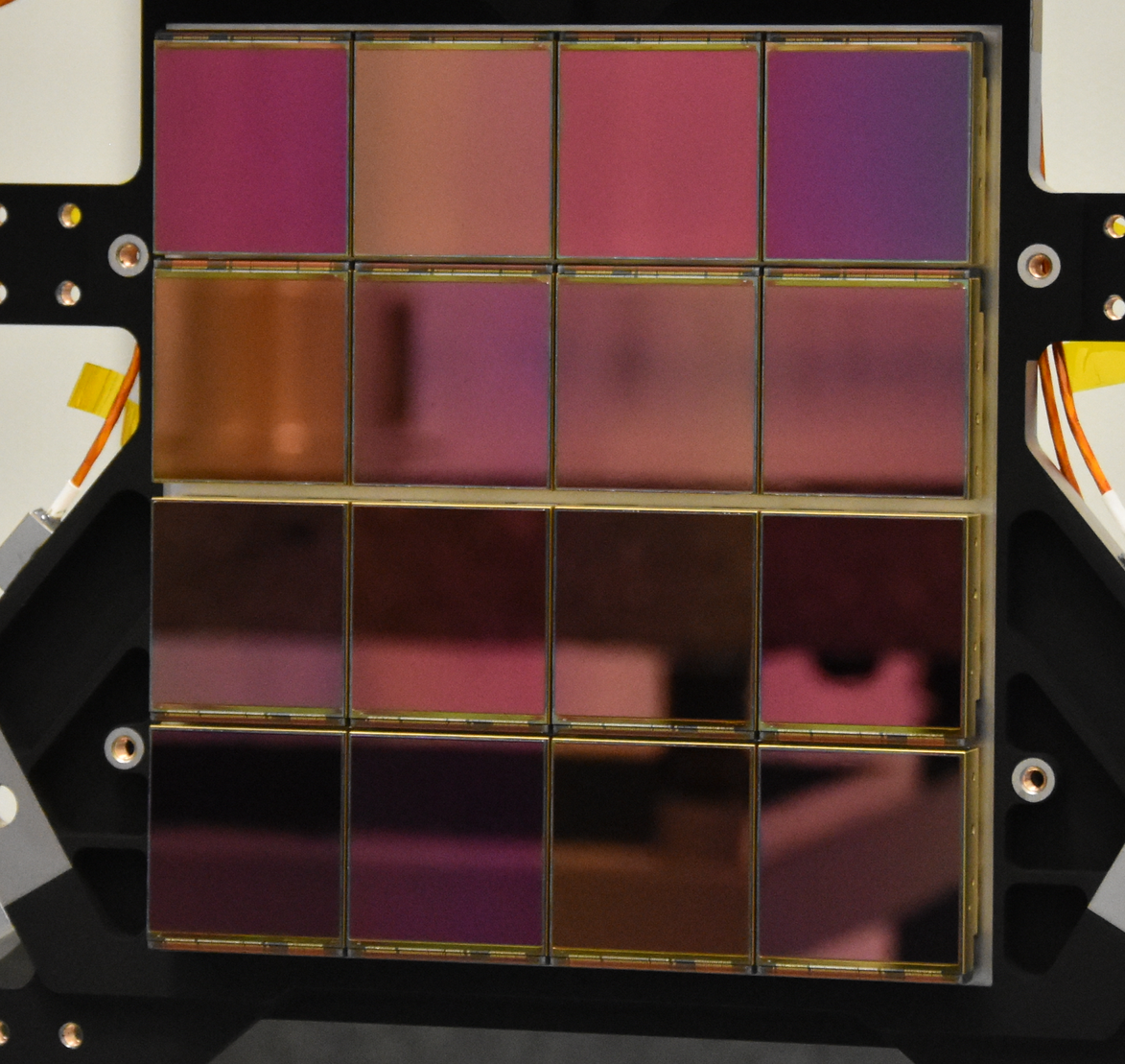
Figure 8: The NISP focal plane array (FPA). Reflective structures can be seen between detectors and around them. Bright stars falling onto them could cause secondary reflections off filters or lenses that propagate back onto the FPA. Image courtesy: Mathieu Niclas, CNRS.
Fulfilled by
Processing output
A set of viewgraphs depicting typical straylight features (if any) caused by detector edges and bolts.
Plots comparing the observed NDI with the respective forecasts. If necessary, the bright star avoidance radius must be adjusted accordingly by EC-SURV.
Required accuracy, constraints
Stars must be sufficiently bright to cause enough scattering signal across the detector so that the ground-based straylight model can be verified.
Quality control parameters
DataModel: https://gitlab.euclid-sgs.uk/
Contact person
NISP-P calibration scientist